Helical and push piers both cost $1,200–$3,000 each in Tyler, within full repairs of $4,000–$15,000. Push piers use house weight to drive to refusal; helicals screw to a measured torque. Structure weight, not preference, decides which one your foundation repair can use.
How each proves capacity, which Tyler structures suit which, and how to read a pier bid.
Two proofs of the same promise
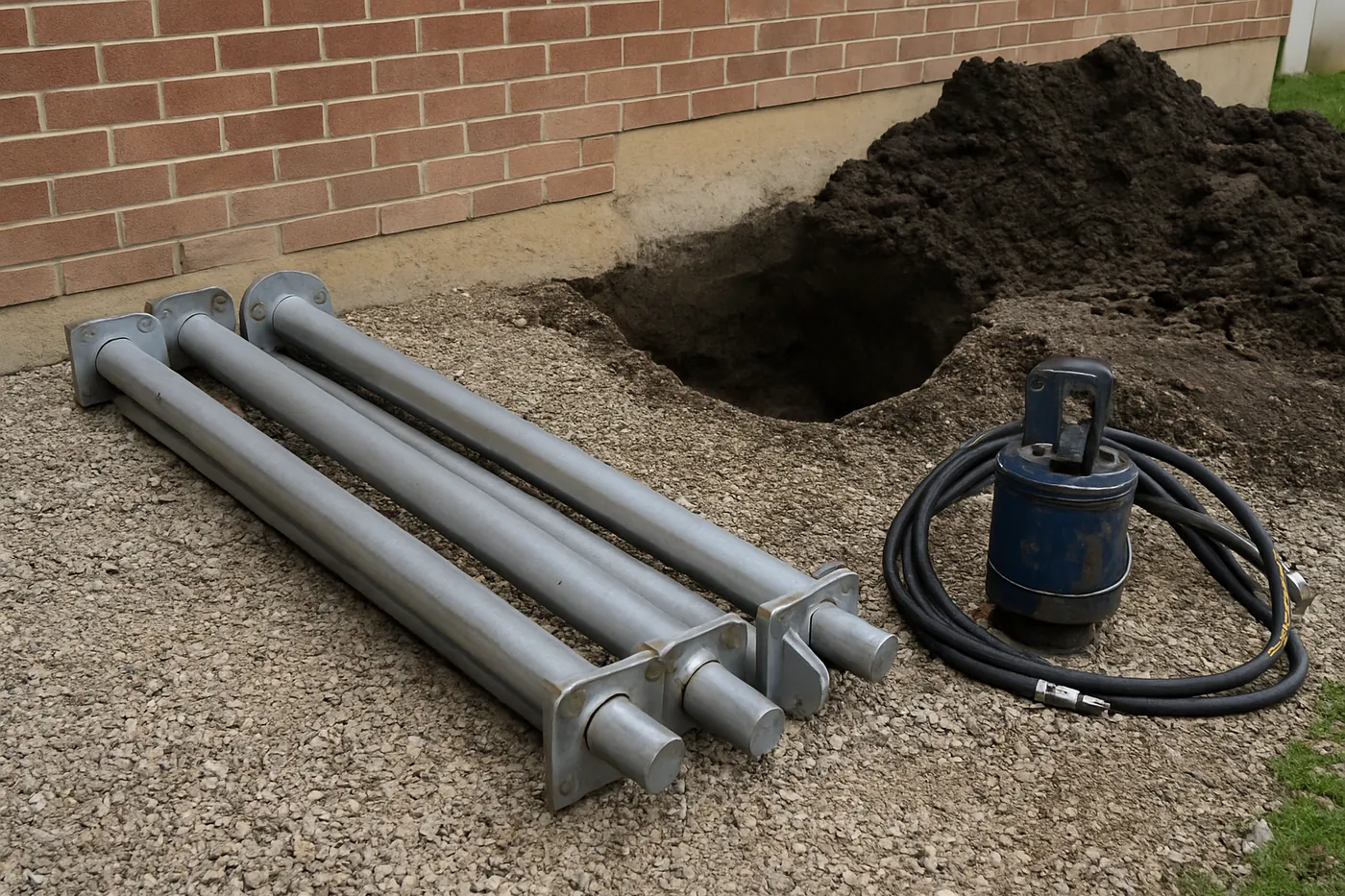
Either type carries the weight of your house down through the clay that shrinks and swells with the weather to firmer ground that does not. What separates them is how each shows it reached that ground. A push pier is pressed down with hydraulic rams that use the house itself as the counterweight, and it is done when it will not go any deeper. Stopping under the real weight of your home is its proof. A helical pier is twisted into the soil while a gauge tracks the turning force, and the force needed at depth indicates how much it can hold. The first proves itself by refusing to move, the second by a reading.
Side by side
| Push piers | Helical piers | |
|---|---|---|
| How it proves its strength | Pushed until it stops under the home's weight | Turning force recorded at final depth |
| Relies on the house's weight | Yes, the house is the counterweight | No, the machine supplies the turning force |
| Suited to | Heavy brick-veneer homes on slabs | Porches, additions, light frame buildings, cramped spots |
| Typical Tyler use | The main house | Stoops, garages, room additions |
| Per-pier cost | $1,200–$3,000 | $1,200–$3,000 |
Reading a Tyler pier bid
An engineered proposal differs from a bare price in four ways. It names the pier type and why it suits your house. It should give count and placement derived from an elevation survey you can look at. It should commit to per-pier logging: refusal depth or torque, pier by pier. And it should specify the lift target: stabilize only, or stabilize and recover a stated amount. Bids that skip all four and arrive as a single number for “foundation repair” are not comparable to each other, which is usually the point.
What the pier warranty is actually worth
Look at the warranty terms before you look at the total. They usually cover what the piers hold up (the supported section carrying its design load), not the whole home and not areas left unpiered. Four questions tell a real warranty from sales literature: can a buyer take it over, is there a transfer fee, does it cover only the piered section or the whole structure, and does it outlast the company if it closes (warranties backed by a third party do; informal ones do not).
With clay this active in Smith County, add a fifth: whether the coverage depends on drainage or perimeter-moisture maintenance you owe. That clause is fair, it is common, and it is the one homeowners meet for the first time during a claim. Keep the install log with it: on East Texas clay, the depth each pier reached is the entire reason the paper means anything.
Pier questions, straight answers
Do the two pier types cost differently in Tyler?
Not dramatically per pier - both land in the $1,200-$3,000 range - but the totals can differ because the designs differ. Helicals are often specified where access is tight or the structure is light, and those jobs sometimes need more of them. The elevation survey and the structure's weight decide the type, and the type decides the count.
Which type fits a typical Tyler slab home?
Push piers, in most cases. A brick-veneer home on a slab is heavy enough to press steel piers down to firm bearing soil, and stopping under the actual weight of the house is proof you can rely on. Helicals make sense for lighter buildings, porches, additions, and front steps that lack the weight a push pier needs.
What is torque and why does it matter?
For helical piers, installation torque correlates to capacity - the harder the pier resists turning at depth, the more load it will carry. It is the helical equivalent of driving a push pier to refusal. Either way you should receive a per-pier log, because that log is the evidence behind the warranty.
Can both types be used on the same house?
Often, and a bid that combines them for good reasons is usually encouraging: push piers beneath the heavy original footing, helicals beneath a lighter addition or porch, with one warranty and logs for both. Be wary of a company that uses a single type everywhere simply because that is the equipment it owns.
How deep do they go on East Texas clay?
Past the active zone where the clay still cycles seasonally, then to refusal or to a tested capacity in stable material below. That depth varies lot to lot across Smith County. Anyone quoting a fixed depth before surveying your house is quoting from a price list rather than designing a repair.
Get a Tyler foundation evaluation
Tell us what the house is doing (stair-step cracks in the brick, doors that stick every August, sloping floors, separating trim) so the evaluation starts from what you have seen. A local specialist who works in Tyler will call you back.